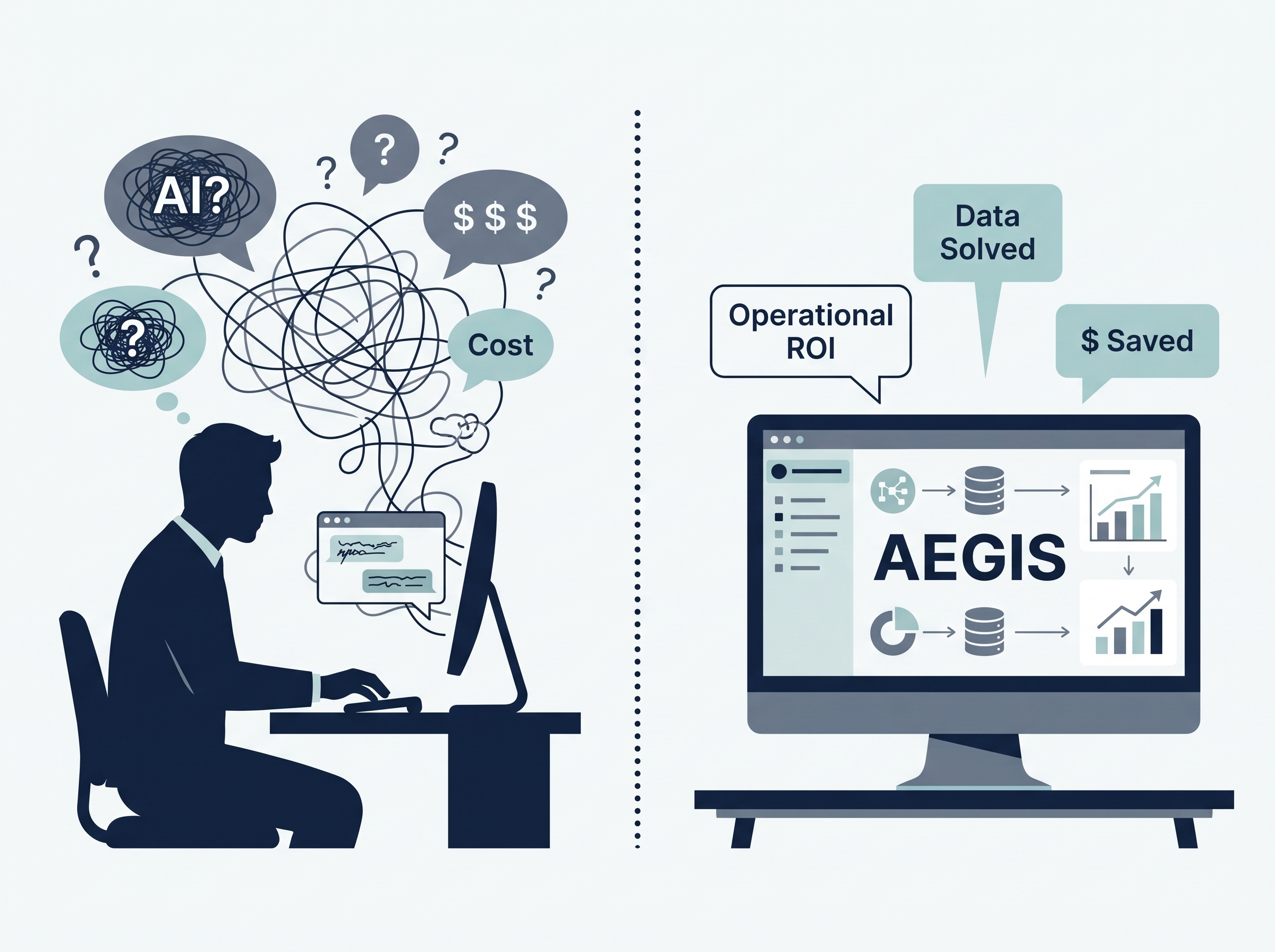
Scroll through business feeds this month and you will encounter the exact same narrative: AI is overhyped, the capital is spent, and leadership isn’t seeing the returns. Industry data frequently shows that up to 84% of CEOs report AI has failed to increase top-line revenue.
Writing in Harvard Business Review, Karim Lakhani, Jared Spataro, and Jen Stave identify this breakdown as the “last-mile problem” of AI transformation: the obstacle holding back enterprise yield is rarely foundational model quality, but rather an organization’s failure to rewire fundamental operating workflows around the tools. As Nathan Furr and Andrew Shipilov warn in HBR’s analysis of the “AI Experimentation Trap,” companies are repeating the costliest mistakes of the early cloud era by treating AI as an open sandbox rather than an instrument linked to unit economics.
When AI initiatives stall, the issue is not model capability. It is architectural direction. Many organizations purchase enterprise seat licenses, drop an open chat interface in front of employees, and expect bottom-line expansion to materialize on its own. That is not an AI transformation strategy; it is an unmeasured software subscription.
Enterprise revenue growth does not stem from tool availability. It requires two concrete operational outcomes:
-
Reclaimed Production Time: High-friction administrative tasks drop from hours to minutes, redirecting labor toward revenue-generating activities.
-
Net-New Capability: Leaders access deep operational transparency that immediately plugs margin leakage or accelerates deals.
Phase 1: Give AI the Back-Office Work Nobody Wants
The quickest path to measurable return is not flashy—it is the operational busywork silently draining payroll. Manual record matching, routine compliance reporting, and multi-day data extractions follow consistent business logic, making them prime candidates for automated workflows.
Automating non-revenue tasks converts overhead into active capacity:
| Operational Workflow | Before Integration | After Targeted AI Integration |
|
Title & Document Ingestion |
Manual, record-by-record data entry with human compliance auditing. |
Hundreds processed daily in minutes with an audit-ready digital register. |
|
Ad-Hoc Business Inquiries |
7+ day wait times, high ticket costs, and outdated data on arrival. |
Sub-5-second verified answers delivered directly from live tables. |
Operational Insight: Time savings only register on the income statement if reclaimed capacity is deliberately redirected into outbound quoting, client retention, and margin management before the rollout begins.
Phase 2: Build Intelligence That Plugs Margin Leaks
Once back-office operational friction is resolved, practical AI generates its strongest yield by uncovering capital already left on the table.
Precision Margin Intelligence
Broad financial dashboards show aggregate gross margins, but they rarely expose where individual accounts leak profit. Tailored AI models analyze real transaction spread—matching true procurement costs against delivered prices rather than inaccurate ledger estimates. The system instantly flags silent price drift, identifies accounts priced well below current peer transactions, and pinpoints supplier cost spikes before they erode contract profitability.
Predictable Customer Restoration
Winning back existing accounts is fundamentally more cost-effective than cold acquisition. Instead of relying on rigid, arbitrary churn definitions (e.g., 90 days inactive), tailored models learn the individual buying cadence of each client account. By consolidating historical ERP records into a clean customer profile, outreach teams know precisely when a key partner goes quiet, prioritized strictly by historical lifetime value.
Action Plan: The Playbook for Measurable AI Yield
-
Map the Labor Drain: Catalog repetitive manual reporting and intake processes across departments and quantify their weekly cost.
-
Automate One End-to-End Workflow: Avoid broad, open-ended pilots. Deploy an operational pipeline that teams actively rely on every day.
-
Pre-Allocate Recovered Hours: Define clear sales, operational, or customer retention targets for the freed capacity.
-
Target Transaction Spreads: Deploy analytical models against customer pricing variances and account retention risks.
-
Measure Incremental Lift: Always validate customer win-back and pricing programs against held-out control groups to prove net-new returns.
This is where Clarabella Consulting & Aegis AI Come In
Scaling beyond seat subscriptions to production AI requires secure infrastructure that connects directly to enterprise databases. That is why Clarabella Consulting implements Aegis AI, a private, on-premise AI platform built for secure enterprise operations.
Rather than sending proprietary datasets outside corporate boundaries or waiting days for technical teams to build custom reports, Aegis AI enables non-technical leadership and operations teams to interrogate relational data structures, log environments and ERP systems using natural language. Questions convert into secure, deterministic queries in seconds, keeping data governance completely intact within local infrastructure.
Stop buying subscriptions that promise generic efficiency. Partner with Clarabella Consulting to deploy Aegis AI and point intelligent automation directly at margin recovery, operational speed and provable ROI. Connect with our experts today.