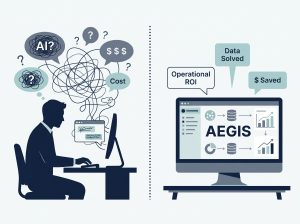
Artificial intelligence has moved well beyond drafting emails and summarizing documents. Today, AI writes code, queries databases, runs multi-step workflows, and interacts directly with connected hardware.
Yet as global AI investment crosses $1 trillion in 2026, a stark paradox has emerged: while nearly 90% of organizations use AI, very few consider their deployments mature or secure enough for full autonomy.
Recent reports from Deloitte, McKinsey, and AvePoint reveal a critical bottleneck. The challenge in 2026 is no longer whether AI is smart enough—it is how to scale autonomous AI when public-cloud models, “Shadow AI,” and unrestricted agent permissions create massive security exposure.
At Clarabella Technical Consulting (CTC), we believe the solution is not to slow down AI adoption, but to rethink where it runs and who controls it.
That philosophy drives Aegis Private AI, our privately deployed platform designed to help businesses harness agentic AI without surrendering control of their data or infrastructure. And that same architecture is unlocking an exciting opportunity at home: a genuinely private, locally hosted voice assistant that delivers the convenience of Amazon Alexa or Google Home without relying on the public cloud.
The 2026 Reality Check: Adoption Is Soaring, Control Is Lagging
As organizations transition from basic chatbots to agentic AI—systems capable of taking autonomous actions across software environments—the risks of public-cloud dependency and poor permission boundaries have become impossible to ignore.
STATE OF AI 2026: RESEARCH HIGHLIGHTS
- 88% Enterprise Adoption: Nearly 9 in 10 organizations use AI, yet McKinsey finds only 1% consider their deployments fully mature.
- 86% Deployment Delays: Organizations delayed AI agent rollouts by an average of nearly 6 months due to unresolved security and governance concerns (AvePoint, 2026).
- 52% Shadow AI Exposure: Over half of employees use unauthorized public AI tools, with 39% uploading confidential company documents (Okta / CSA, 2026).
- 88.4% Agent Security Incidents: Nearly 90% of surveyed organizations reported at least one AI agent security incident or data leak in the past year (AvePoint, 2026).
Sources: AvePoint (June 2026), Deloitte (2026), McKinsey (2026), and Cloud Security Alliance / Okta (July 2026).
While executive enthusiasm remains high, Deloitte reports that only 25% of enterprises have moved 40% or more of their AI pilots into production. Giving a cloud-hosted model access to sensitive ERP records, financial documents, or APIs without strict architectural boundaries simply creates too much risk.
What Leading Research Reveals About the Governance Gap
Across the industry, researchers are sounding the same alarm: AI agents are scaling faster than the systems designed to control them.
- The Shadow AI Blindspot: A July 2026 study by the Cloud Security Alliance (CSA) and Okta found that while 90% of executives believe they have visibility into company AI usage, over half of employees paste internal data into unsanctioned public tools. Worse, only 34% of organizations apply the same access controls to AI agents as they do to human employees.
- Data Leaks & Prompt Injection: AvePoint’s 2026 report found that half of all AI agent incidents stem from data leakage (50.1%) and manipulation via untrusted inputs or prompt injection (49.6%).
- Local Hardware Proliferation: Anthropic’s October 2026 research demonstrated that compact 9B to 26B parameter models can run distributed inference across $55 consumer Android TV boxes—showing both the power of small, local models and the danger of unrestricted network permissions.
Together, these findings reinforce a core principle: Trust in AI cannot rely on user policies or the AI choosing to behave. It must be enforced by the architecture surrounding it.
The Bottleneck Isn’t Capability. It’s Unrestricted Access.
When an enterprise hesitates to move an AI project into production, the problem is rarely the model’s intelligence. It is what happens when organizations rely on public-cloud tools or poorly scoped agents:
- Data leaves the building and is transmitted to third-party servers.
- Over-privileged agents given broad API credentials can modify production records or expose restricted files.
- Prompt injection attacks can trick an agent reading an external email or invoice into executing unauthorized commands.
Banning AI only drives employees toward Shadow AI. The real solution is providing a sanctioned, high-performance AI environment inside your own digital walls, governed by an orchestration layer that verifies every action.
Aegis Private AI: Enterprise Intelligence, Under Your Control
Aegis Private AI, developed by Clarabella Technical Consulting, solves the “pilot-to-production” bottleneck by bringing advanced AI directly onto infrastructure you control—on-premises or in a dedicated private environment.
- Private AI Conversations: Give employees a secure workspace on company infrastructure, eliminating the need to paste confidential data into public chatbots.
- Ask & Answer: Query ERP systems, databases, and APIs using natural language while respecting role-based user permissions.
- Document Intelligence: Process invoices, purchase orders, and contracts without exposing records to outside providers.
- Scoped AI Agents: Automate multi-step workflows and bridge legacy software systems safely.
- Hermes Orchestration: Coordinate models, enforce security policies, manage tool access, and log every interaction.
How Aegis Bridges the Governance Gap
CTC pairs private deployment with defense-in-depth controls centered around Hermes, Aegis’s security and orchestration boundary:
| Architectural Layer | Role in the Aegis Ecosystem |
| 1. Authorized Users & Apps | Initiates business requests and approved workflow triggers. |
| 2. Hermes Orchestration | Enforces identity checks, permissions, policy guardrails, and approvals. |
| 3. Private LLM | Performs reasoning within a restricted, isolated inference boundary. |
| 4. Approved Tools & Data | Connects only to scoped databases, APIs, and verified internal systems. |
| 5. Infrastructure Security | Maintains network isolation, restricted credentials, and audit logging. |
With Hermes acting as the gatekeeper, an AI agent can analyze inventory, spot a shortage, and draft a purchase order in seconds—but submitting that order or modifying records requires independent authorization. You get the full productivity of modern AI while keeping the keys to your infrastructure.
From the Factory Floor to the Living Room: Private AI for Your Home
The breakthroughs shaping enterprise AI in 2026—high-efficiency local models and strict orchestration—are also transforming the smart home.
Millions of households use Amazon Alexa or Google Home, but those platforms depend on third-party clouds, internet connectivity, and always-on microphones sending data to outside servers.
Aegis Private AI can serve as the conversational brain behind a locally hosted smart-home assistant, paired with local platforms like Home Assistant and local protocols like Zigbee, Z-Wave, and Matter.
Imagine saying:
“Good morning, Aegis.”
Your assistant turns on kitchen lights, adjusts the thermostat, reads your locally stored calendar, and summarizes overnight sensor activity.
Or imagine asking:
“Aegis, we’re leaving for the weekend. Set the house to away mode.”
The assistant lowers the thermostat, turns off lights, verifies door locks, and arms your security system—all without a single word leaving your home network.
What an Aegis-Powered Home Assistant Can Do
- Control Your Home: Manage lights, thermostats, blinds, and switches using natural conversation.
- Manage Daily Tasks: Organize local calendars, grocery lists, and family reminders (with optional external calendar sync).
- Monitor Security: Connect local cameras and sensors to report activity and trigger automated routines.
- Conversational Assistance: Get help with recipes, homework, and general questions using local speech recognition and synthesis.
- Control Entertainment: Operate compatible TVs, receivers, and local media servers hands-free.
[ Voice Commands ]        --> Microphones & local speech recognition
       |
       v
[ Aegis Private AI ]      --> Understands intent & checks security rules
       |
       v
[ Local Home Automation ] --> Home Assistant & local protocols (Zigbee, Z-Wave, Matter)
       |
       +---> [ Lighting ]   [ Climate ]   [ Security ]   [ Entertainment ]
Core automations and voice commands keep working even during an internet outage. When external data like live weather or streaming music is needed, you choose when and how the system connects.
A Private Home Assistant Must Also Be a Secure One
Whether in a manufacturing plant or your living room, privacy without permission control is still a risk. CTC applies the same enterprise security principles to home automation:
- Scoped Access: Your assistant can turn on the kitchen lights without having network access to your home office computer or financial files.
- Tiered Authorization: Routine requests happen instantly, while sensitive actions—like unlocking doors, opening the garage, or disarming alarms—require explicit confirmation or a PIN.
- Network Isolation: Smart home devices stay isolated from personal computers and sensitive systems.
Why Private AI Is the Ultimate Competitive Advantage
Deloitte’s 2026 research shows that organizations with mature AI governance see a 28% increase in staff actively using AI and deploy it across three times as many business areas as peers without strong controls.
- Manufacturing & Supply Chain: Connect Aegis to ERP and inventory data to spot bottlenecks and prepare purchase requests without replacing legacy systems or exposing proprietary data.
- Healthcare, Legal & Finance: Search internal records, contracts, and compliance documents in seconds with zero risk of client data training a public model.
The Future of AI Is Private, Practical, and Accountable
The State of AI in 2026 proves that artificial intelligence is an operational necessity. But relying on unsanctioned public tools or deploying agents without strict guardrails is not a sustainable strategy.
Whether for your business or your home, the essential questions are the same: Where does the AI run? Who controls the data? What actions can it take? And how are those boundaries enforced?
With Aegis Private AI, Clarabella Technical Consulting puts powerful intelligence directly under your control—helping businesses move safely from pilots to production, and empowering homeowners to build smarter, genuinely private homes.
About Clarabella Technical Consulting and Aegis Private AI
Clarabella Technical Consulting, LLC (CTC) builds practical, security-first solutions that help organizations modernize operations, connect existing systems, and apply AI to real-world challenges. Aegis Private AI unites private conversational intelligence, live data querying, document processing, and Hermes-governed workflows for businesses and local smart-home environments.
Contact Clarabella Technical Consulting today to learn how Aegis Private AI can support your business or home automation environment.
Sources and Further Reading
- AvePoint — The State of AI 2026: Trust, Control, and the Rise of AI Agents (June 2026)
- Cloud Security Alliance & Okta — The Hidden Risks of the Agentic Enterprise (July 2026)
- Deloitte — State of AI in the Enterprise 2026 & APAC Trustworthy AI Report (2026)
- McKinsey & Company — The State of AI: Global Survey (2026)
- Anthropic — AI Models May Be Capable of Self-Replicating Without Access to a Datacenter (October 12, 2026)
Editorial note: This article distinguishes Aegis’s core enterprise capabilities from deployment-specific security configurations and proposed residential integrations. Offline functionality and security boundaries depend on hardware selection, network configuration, and validated deployment parameters.