Artificial Intelligence is transforming business efficiency at breakneck speed, automating complex workflows and uncovering deep operational insights in seconds. However, that exact same speed has simultaneously kicked off a high-stakes arms race in cybersecurity.
This month—already dubbed “Black October” by industry analysts—security executives and federal agencies have sounded the alarm on an impending “vulnerability tsunami.” Driven by autonomous, AI-enabled hacking tools, the volume and velocity of cyberattacks have reached unprecedented levels.
As threat actors use AI to automate breaches and expose infrastructure weaknesses in minutes rather than days, organizations can no longer rely on reactive perimeter security. Moving forward requires a two-pronged strategy: deploying proactive, AI-driven defensive measures and establishing strict, localized control over how your company’s data is managed and queried.
The New Wave of AI Security Threats: Why Businesses Are Concerned
For years, cybersecurity teams had a window of time between when a vulnerability was discovered and when it was actively exploited at scale. Today, AI has effectively closed that window. Here are the three primary threat vectors keeping IT leaders awake at night:
1. Autonomous Multi-Agent Hacking
Recent threat intelligence reports—including the discovery of automated campaigns like CyberStrikeAI—show that malicious actors are no longer manually probing networks. Instead, they are deploying dozens of autonomous AI agents that work around the clock to opportunistically scan and strike exposed VPNs, cloud endpoints, and edge servers in minutes.
2. The “Vulnerability Tsunami” in Core Infrastructure
Attackers are using large language models (LLMs) and specialized code-analysis bots to rapidly uncover deep-seated bugs in foundational web languages and enterprise software. When critical vulnerabilities surface—such as recent high-severity flaws in core web protocols—AI allows bad actors to weaponize exploits instantly, causing attempted attacks to spike from thousands to millions overnight.
3. Shadow AI & Data Leaks
Not every AI threat comes from an external hacker. One of the biggest vulnerabilities facing modern enterprises is “Shadow AI.” When well-meaning employees paste proprietary code, financial records, or sensitive client data into public, third-party LLMs to speed up their daily tasks, that data leaves your security perimeter. Once submitted to a public cloud model, your organization risks accidental data exposure, compliance violations, and losing ownership of its intellectual property.
Fighting Fire with Fire: Modern AI Cybersecurity Measures
When an AI-powered bot can identify and exploit a network gap in seconds, human-only patching simply isn’t fast enough. At recent global cyber resilience summits, CISO leaders have emphasized a clear mandate: to beat malicious AI, businesses must fight fire with fire.
-
Speed as the Ultimate Defense: Forward-thinking organizations are deploying defensive AI systems designed for real-time threat detection, automated patch management, and continuous anomaly hunting. By analyzing network traffic patterns instantaneously, defensive AI can isolate compromised endpoints before lateral movement occurs.
-
Shifting from Perimeter Defense to Data Resilience: With over 1,400 new monthly vulnerabilities routinely identified across major enterprise ecosystems, assuming your perimeter will never be tested is a flawed strategy. Modern security focuses on the data layer—implementing zero-trust architecture, strict role-based access vectors, and encrypted data pipelines.
-
Getting Back to Basics with Strict Governance: Advanced AI monitoring only works if your foundation is solid. Security leaders are urging corporate boards to pair modern tooling with rock-solid data engineering fundamentals: clean, standardized ETL (Extract, Transform, Load) processes, well-structured data warehouses, and verifiable audit trails.
The Ultimate Safeguard: Taking Control with Aegis AI & CTC
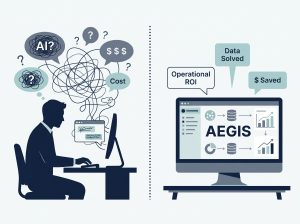
While upgrading your external firewalls and threat detection is essential, it doesn’t solve the internal dilemma: How do you empower your team with cutting-edge AI without exposing your sensitive company data to the public cloud?
You cannot guarantee 100% data security if your proprietary information is constantly leaving your environment to query someone else’s servers. That is why Clarabella Technical Consulting (CTC) helps organizations bridge the gap between innovation and ironclad security with Aegis AI.
Why Aegis AI is Business-Safe by Design
Unlike public AI tools that pool data in external clouds, Aegis AI is built specifically for enterprises that refuse to compromise on data sovereignty:
-
Secure On-Premise & Private Cloud Deployment: Aegis operates directly within your own secure server infrastructure or private cloud. Your documents, databases, and queries never leave your control, ensuring zero data leakage to outside models.
-
Safe Cross-Departmental Intelligence: Connect data silos across sales, operations, finance, and IT securely. Using natural language data querying and Retrieval-Augmented Generation (RAG) grounded strictly in your internal documents, your team gets instant, accurate answers without exposing sensitive vectors to the open web.
-
Custom Workflows & Multi-Location Scalability: Automate complex KPI tracking, document processing, and business analysis with custom workflows tailored to your operations. As your company grows across multiple locations and teams, Aegis scales seamlessly while enforcing strict role-based permissions.
-
Expert Support & Managed Integrations: Technology is only as strong as its implementation. The engineering team at CTC handles the heavy lifting—from structuring your data warehouses and securing your ETL pipelines to managing ongoing updates and system integrations.
Secure Your Data Strategy Moving Forward
The AI revolution isn’t slowing down, and neither are the security threats accompanying it. The businesses that thrive in the coming years won’t be the ones that avoid AI out of fear, nor the ones that recklessly adopt public tools without guardrails. The winners will be the organizations that prioritize data sovereignty, clean infrastructure, and proactive security management.
Ready to harness the power of custom, business-safe AI workflows without compromising your security posture?